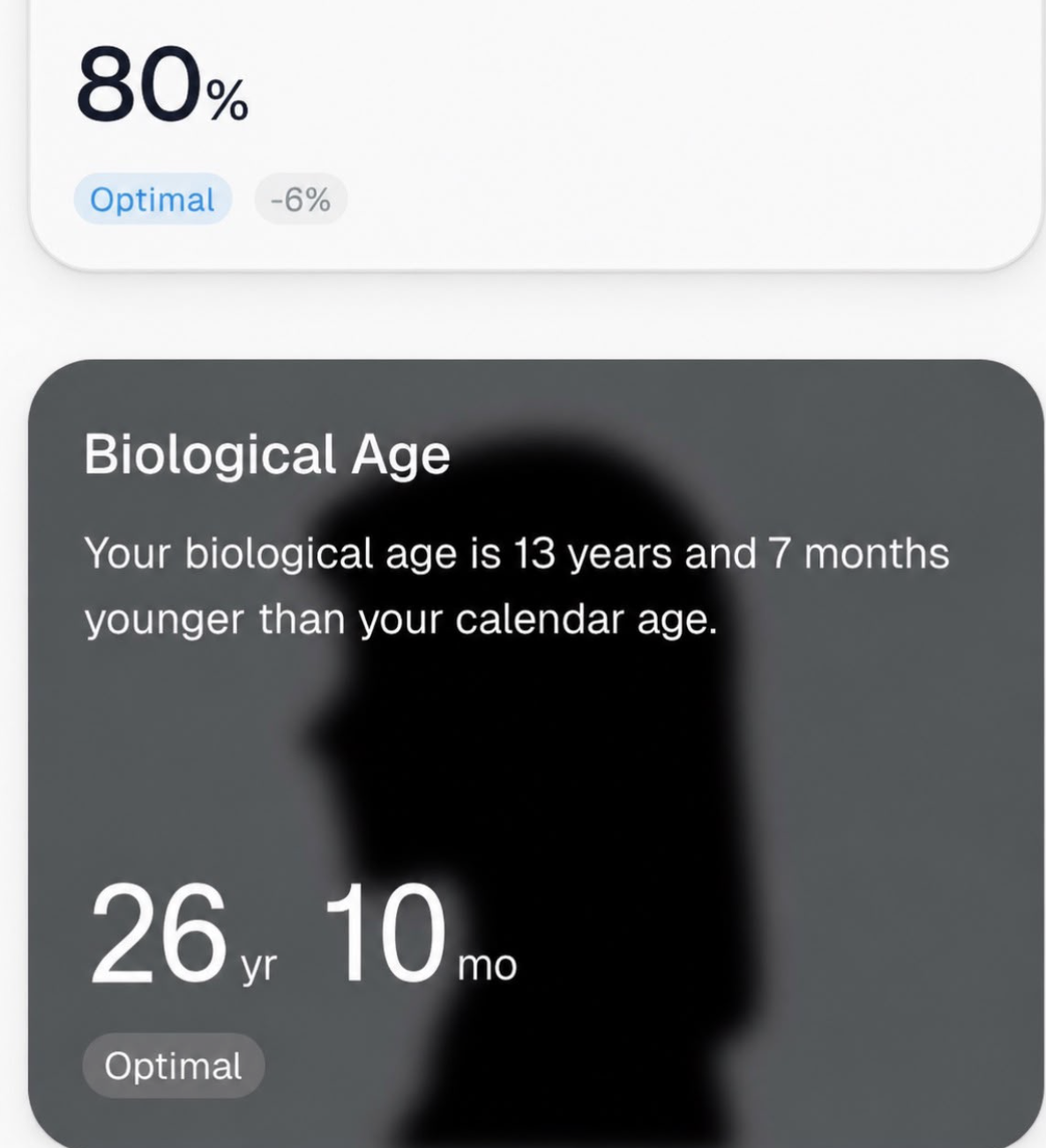
I want to be honest about something up front. Aging itself is not what I am afraid of.
What I am interested in is the gap between the number of birthdays I have had and the way my body is actually functioning underneath — my biological age. And here is the part that changed everything for me: biological age is not a fixed number. It is shaped by measurable things — inflammation, insulin sensitivity, muscle mass, mitochondrial function, sleep quality, body composition, even how my skin and hair are behaving. Those things respond to how I live.
I am not interested in accepting decline simply because another birthday happened.
I care about function. How strong I am. How I recover. My energy. My metabolic health. My body composition. My skin, my hair. How the whole system is running. That is the conversation I want to be in — not chasing a younger number on a test, but building a body that keeps performing at a level I refuse to let slip.
The New Conversation Around Aging
For a long time, “anti-aging” meant creams, cosmetic tweaks, and hoping nobody noticed. The modern longevity conversation is much bigger than that.
We are now looking at muscle and metabolic health. Mitochondrial function and cellular energy. Chronic inflammation. Sleep and recovery. Nutrition quality. Cellular signaling. We are measuring how the body is actually working underneath the surface, and then we are influencing those systems on purpose.
That is the shift — from hoping aging is kind to actively shaping the way your body ages. It is also the setup for everything that follows. The seven sections below are the framework I personally use, and none of them lives in isolation. Muscle affects metabolic health. Sleep affects recovery. Nutrition affects your ability to maintain muscle. Cellular energy matters to performance. Stress affects sleep. The peptide is not the entire protocol. Longevity is a system.

1. Muscle Is Longevity Insurance
Muscle mass naturally declines with age unless you actively maintain it — and that decline is associated with reduced metabolic rate, increased insulin resistance, and higher mortality risk. Muscle is not only about how you look. It supports physical function and independence, and it is closely connected with metabolic health. Resistance training also supports bone and physical capacity as we age.
So I train like it matters, because it does. Progressive resistance. Weighted, strength-focused movements. Consistent movement every day. Adequate protein to actually maintain the muscle I am asking my body to build.
I train because I want to look strong and sculpted — and I train because I want a body that is still performing at an elite level decades from now. The same work that shapes me now is the work that keeps me standing, moving, and capable later. That is the real reason this is section one.
Muscle isn’t about aesthetics. It’s about survival and metabolic resilience.
2. I Protect NAD and Mitochondrial Function
NAD+ is a coenzyme involved in cellular energy metabolism, redox reactions, and processes involved in cellular maintenance. NAD+ levels decline as we age — starting as early as your twenties. Mitochondria are central to energy production, so this part of longevity matters to me because I care about maintaining energy, recovery, and cellular function rather than waiting until I feel depleted to think about it.
I also support this pathway with MOTS-c, a mitochondrial-derived peptide being studied for metabolic and cellular signaling. I describe it accurately: it is being researched for metabolic regulation and mitochondrial resilience, not presented as a guaranteed human anti-aging outcome.
When these systems are compromised, the body reflects it — lower energy, slower recovery, impaired cellular repair. When they are supported, you feel that too. This is why I pay attention to mitochondrial health long before there is a problem to fix.
3. I Use Targeted Peptides to Support Specific Systems
Once the foundation is in place, I layer in peptides that target very specific functions. The key philosophy here is that I do not believe in taking everything at once, forever. I use targeted compounds according to the specific goals I am working on, and my plan is customized and adjusted through Luxury Medical Group.
Targeted does not mean “take more.” It means having a reason for everything that is there.
Metabolic and body-composition support. Compounds used around metabolic health, inflammation, and body composition — not extreme weight loss, but a more efficient, less inflamed baseline. Someone focused here is usually working toward how their body composition and metabolic function are aging.
Reproductive and hormonal signaling. Compounds that support the body’s natural hormone signaling rather than overriding it. This is relevant when hormonal balance, cycle regularity, or reproductive health are part of the conversation.
Regenerative and beauty support. Compounds studied for tissue repair, skin, and hair pathways — the layer of the conversation that shows up in the mirror. Someone focused here is usually working on skin quality, recovery, and the visible side of aging.
Antioxidant support. Compounds that support the body’s antioxidant defense and detox pathways, reducing oxidative stress — one of the biggest drivers of aging, internally and externally.
Longevity-focused signaling. Compounds being studied for cellular health and longevity pathways over time — the long-game layer of the plan.
Some of these compounds are investigational and not FDA-approved for an anti-aging indication, so I never present them as approved anti-aging treatments. This is a personalized, supervised plan, not a shopping list.
Every part of my protocol has a job.
I’m not trying to build the biggest stack. I’m trying to build the smartest one for the version of my body I’m trying to create.